Rose Cut vs. Old Mine Cut Diamonds: What's the Difference?
If you love antique jewelry, you've probably come across two names again and again: rose-cut diamonds and old mine-cut diamonds.
Both are strongly associated with antique jewelry, both have a wonderfully distinctive sparkle, and both are very different from the modern brilliant-cut diamonds we see today.
But what exactly makes them different?
The easiest way to remember it is simple:
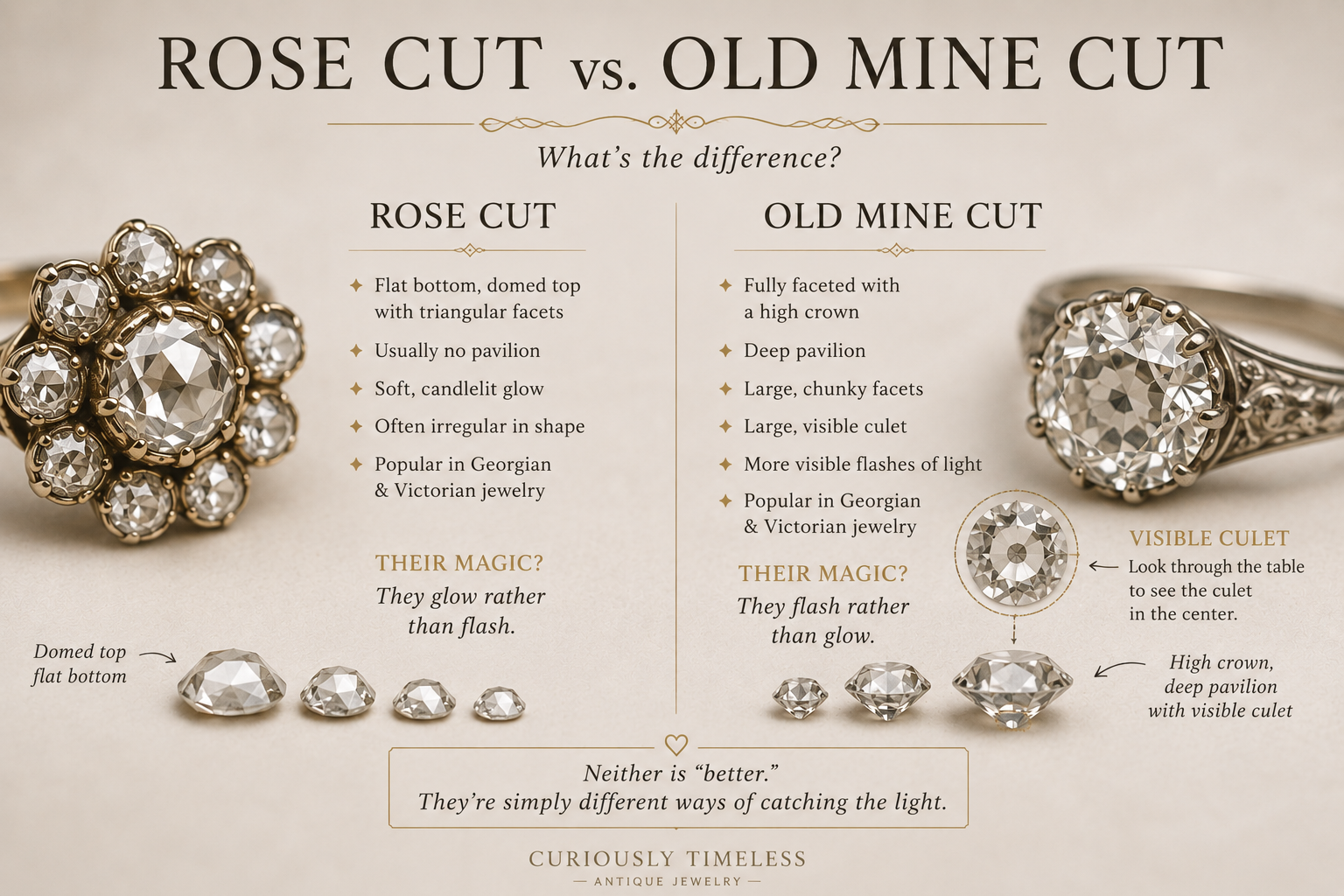
Rose cuts glow. Old mine cuts flash.
But there is much more to the story.
Rose-Cut Diamonds
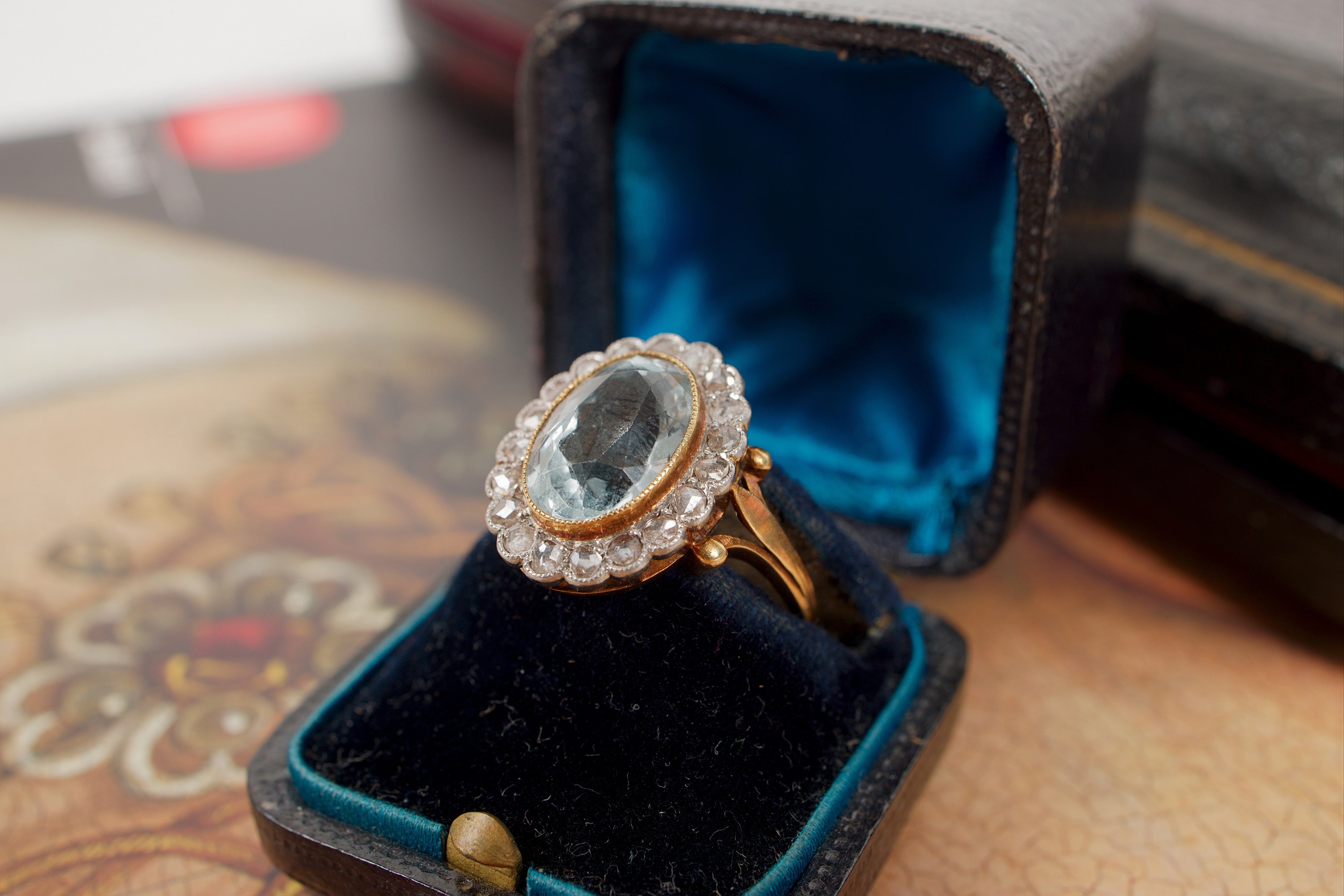
The rose cut is one of the oldest diamond cuts still found in antique jewelry. It became particularly popular from the Georgian period through the Victorian era and continued to be widely used throughout the 19th century.
A rose-cut diamond has a flat or slightly curved base and a domed top covered with triangular facets. Unlike a modern brilliant cut or an old mine cut, it generally has no pavilion beneath the stone.
The number and arrangement of facets can vary considerably, especially in older examples. Antique rose cuts are often slightly irregular in shape, which is part of their charm.
A softer kind of sparkle
Rose-cut diamonds don't sparkle in quite the same way as modern brilliant-cut diamonds.
Their broad, simple facets create a soft, subtle glow rather than a multitude of sharp flashes.
This is particularly beautiful in antique jewelry, where rose cuts were often arranged in clusters or pavé settings. Under candlelight or softer natural light, an entire jewel can seem to shimmer rather than flash.
This is one of the reasons we have such a soft spot for them.
Rose cuts glow rather than flash.

Old Mine-Cut Diamonds
Old mine-cut diamonds belong to a later stage in the history of diamond cutting and were particularly popular during the Georgian and Victorian periods, before modern cutting techniques became widespread.
Unlike a rose cut, an old mine cut has a fully developed crown and pavilion, giving the diamond considerably more depth.
It typically features:
-
A high crown
-
A relatively small table
-
A deep pavilion
-
Large, chunky facets
-
A rounded or slightly irregular outline
-
A large, open culet
These diamonds were generally cut by hand, so no two stones are necessarily identical. Slight asymmetry, uneven proportions and unusual outlines are common — and are part of what makes antique diamonds so charming.

The Culet: One of the Easiest Ways to Recognize an Old Mine Cut
One of the most distinctive characteristics of an old mine-cut diamond is its large, open culet.
Unlike a modern brilliant-cut diamond, whose pavilion typically comes to a sharp point, an old mine cut usually has a flat facet at the very bottom of the pavilion.
When you look down through the table of the diamond, this culet can often be clearly seen with the naked eye, appearing as a small geometric shape at the very center of the stone.
It can look almost like a little window or dark point floating beneath the table.
For anyone learning to identify antique diamond cuts, this is one of the easiest details to look for.
See a distinct culet through the center of an old diamond? You may well be looking at an old mine cut.
Rose cuts, by contrast, are much shallower and generally have a flat back rather than a deep pavilion and open culet.
Chunky Flashes of Antique Sparkle
Because of their deeper construction, high crown and larger facets, old mine-cut diamonds tend to produce more noticeable flashes of light than rose cuts.
They don't have the precise, uniform scintillation of a modern brilliant cut. Instead, they have a wonderfully chunky and lively sparkle.
As the diamond moves, large facets catch the light and create flashes that appear and disappear.
And then there is that beautiful culet, often visible right in the center, giving old mine cuts a look that is immediately recognizable to the eye.
Old mine cuts flash rather than glow.
Rose Cut vs. Old Mine Cut at a Glance
| Rose Cut | Old Mine Cut | |
|---|---|---|
| Structure | Shallow, flat-backed | Deep, with crown and pavilion |
| Top | Domed | High crown |
| Facets | Simple triangular facets | Larger, chunky facets |
| Pavilion | Generally absent | Deep pavilion |
| Culet | No visible culet | Large, visible/open culet |
| Shape | Often irregular | Rounded, often irregular |
| Sparkle | Soft, candlelit glow | Chunky, lively flashes |
| Periods | Georgian & Victorian | Georgian & Victorian |
Why Do Antique Diamonds Look So Different?
Neither rose-cut nor old mine-cut diamonds was designed to look like a modern brilliant-cut diamond.
And that's exactly why we love them.
Modern diamond cutting is largely focused on maximizing brilliance, symmetry and optical performance. Antique diamonds were cut by hand, using techniques and tools very different from those available today.
The result is a wonderful individuality.
One diamond may be slightly elongated. Another may have a large culet. Another may have an asymmetrical outline or an unusual facet arrangement.
These characteristics aren't necessarily imperfections to be corrected.
They are part of the identity of the stone.
Which One Is Better?
Neither.
Rose cuts and old mine cuts were created differently, and they produce completely different effects.
A rose-cut diamond can appear wonderfully quiet and understated, then come alive in candlelight.
An old mine cut can give you those irresistible, chunky flashes of light — especially when the jewel is moved.
So choosing between them is really a question of personality.
Do you prefer the soft, romantic glow of a rose cut?
Or the dramatic, lively flashes of an old mine cut?
Why We Love Both
For us, the beauty of antique diamonds isn't about finding the most perfectly proportioned stone.
It's about finding the stone with character.
A rose cut with a beautifully broad dome.
An old mine cut with wonderfully chunky facets and a prominent culet.
A slightly irregular diamond that catches the light in an unexpected way.
These stones have something that can be difficult to reproduce today: individuality.
They remind us that the diamond was shaped by hand, long before computerized cutting and precision machinery.
And perhaps that's why they work so beautifully in antique jewelry.
They don't simply reflect the light.
They carry the history of the jewel with them.
So, rose cut or old mine cut?
Rose cuts glow. Old mine cuts flash.
We'll happily take either. But if you know us, you'll probably have noticed that we have a particularly soft spot for those quiet, romantic little rose-cut diamonds. 🤍


Leave a comment
This site is protected by hCaptcha and the hCaptcha Privacy Policy and Terms of Service apply.